
.png)
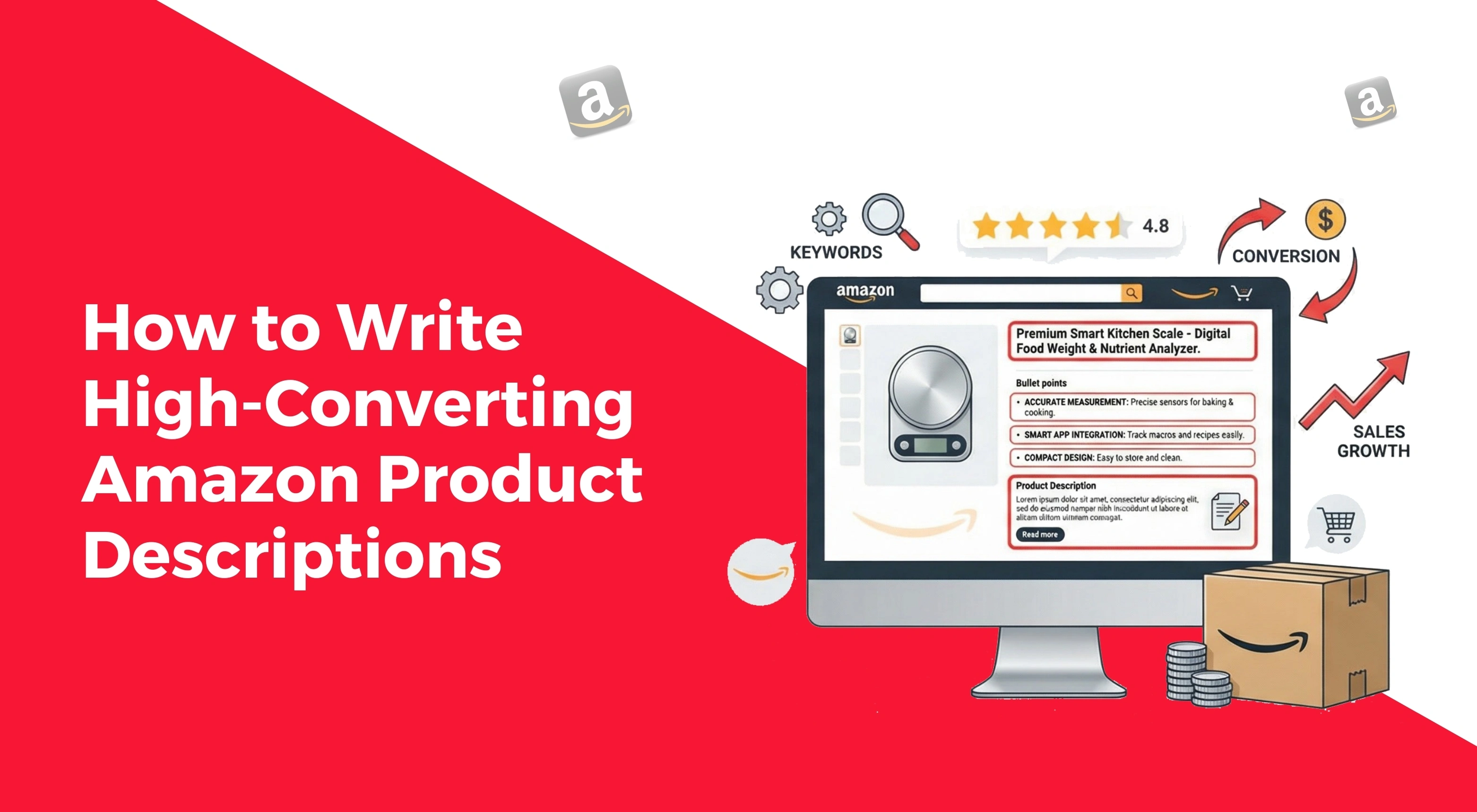
We can say that selling on Amazon is highly competitive; thus, staying ahead of your competitors requires proper knowledge and awareness about Must-Have Amazon Store Management Services, along with writing a High-Converting Amazon Product Description.
Here’s a clear, practical, and user-friendly guide you can use directly for your product description: “How to Write High-Converting Amazon Product Descriptions.” It’s written with conversion psychology and Amazon SEO in mind.
How to Write High-Converting Amazon Product Descriptions
Amazon product descriptions are not just about explaining a product — they’re about persuading buyers to click “Add to Cart.” A high-converting description combines clarity, benefits, trust signals, and SEO while staying compliant with Amazon’s policies.
1. Understand Amazon’s Content Structure First
Before writing, know where your description fits:
- Title → Search visibility and quick value
- Bullet Points (Key Features) → Benefits and objections
- Product Description → Storytelling and reassurance
- A+ Content (if eligible) → Visual selling and branding
Important: Most buyers read bullets first, then scan the description.
2. Start with Customer Intent, Not Features
Ask:
- Why is the customer searching for this product?
- What problem are they trying to solve?
- What frustration do competitors fail to address?
Feature-focused:
“Made with stainless steel.”
Benefit-focused:
“Made with premium stainless steel to resist rust, stains, and daily wear.”
Rule: Every feature must answer “So what?”
3. Use the PAS Formula for Strong Conversions
A proven copywriting formula for Amazon:
P – Problem Highlight the customer pain point.
A – Agitate Explain why it’s frustrating or costly.
S – Solution Position your product as the answer.
Example: “Tired of chargers that overheat and damage your phone? Overheating shortens battery life and puts your device at risk. Our fast-charge cable uses heat-control technology for safe, reliable charging every time.”
4. Write Scannable, Persuasive Paragraphs
Most shoppers skim, not read.
Best Practices:
- Short paragraphs (2–3 lines)
- Use bold or caps sparingly
- Avoid large text blocks
- Focus on clarity over creativity
Structure Example:
- Opening benefit statement
- 2–3 supporting benefits
- Proof or reassurance
- Clear use case
5. Naturally Include SEO Keywords (No Stuffing)
Amazon SEO matters, but readability comes first. Avoid excess keywords and focus on natural placement.
Where to place keywords:
- First 1–2 lines of the description
- Naturally within benefit statements
- Synonyms and variations (not repetition)
Keyword stuffing:
“Best wireless earbuds for phone wireless earbuds Bluetooth”
Natural usage:
“These wireless earbuds deliver crystal-clear sound with stable Bluetooth connectivity for phones, tablets, and laptops.”
6. Address Objections Before They Arise
High-converting descriptions reduce hesitation by addressing buyer concerns early.
Common buyer concerns:
- Will it fit?
- Is it durable?
- Is it easy to use?
- Is it worth the price?
Example: “Designed for beginners — no tools or technical setup required.”
7. Use Sensory and Outcome-Driven Language
Help buyers visualize ownership.
- Instead of “lightweight” → “easy to carry all day”
- Instead of “powerful motor” → “effortlessly handles tough tasks”
- Instead of “soft fabric” → “gentle on skin, even after hours of wear”
This emotional connection boosts conversions.
8. Build Trust with Social Proof and Guarantees
Even within the description, trust signals matter:
- Quality certifications
- Warranty or guarantee
- Usage numbers (“Trusted by 100,000+ customers”)
- Compatibility or safety standards
Example: “Backed by a 12-month warranty and responsive customer support.”
9. Stay Amazon-Policy Compliant
Avoid:
- Pricing, discounts, or promotional language
- Claims like “#1 best seller” unless verified
- External links
- Excessive capitalization or symbols
Policy-compliant content leads to fewer suppressions and better longevity.
10. End with a Soft Call-to-Action
Amazon doesn’t allow aggressive CTAs, but subtle encouragement works.
Examples:
- “Ideal for daily use at home or work.”
- “Perfect for gifting or personal use.”
- “Designed for long-lasting performance you can rely on.”
Also, read the blog below to understand the Amazon store management services needed for scalability and profitability.
Must-Have Amazon Store Management Services for Every Seller in 2026
Conclusion
A proper, profitable Amazon listing requires a well-written product description that resonates with customers and motivates them to take action.
If you have any questions related to Amazon product listing, optimization, or account management, contact Arvian Business Solutions today for expert guidance and scalable growth solutions.