
.png)
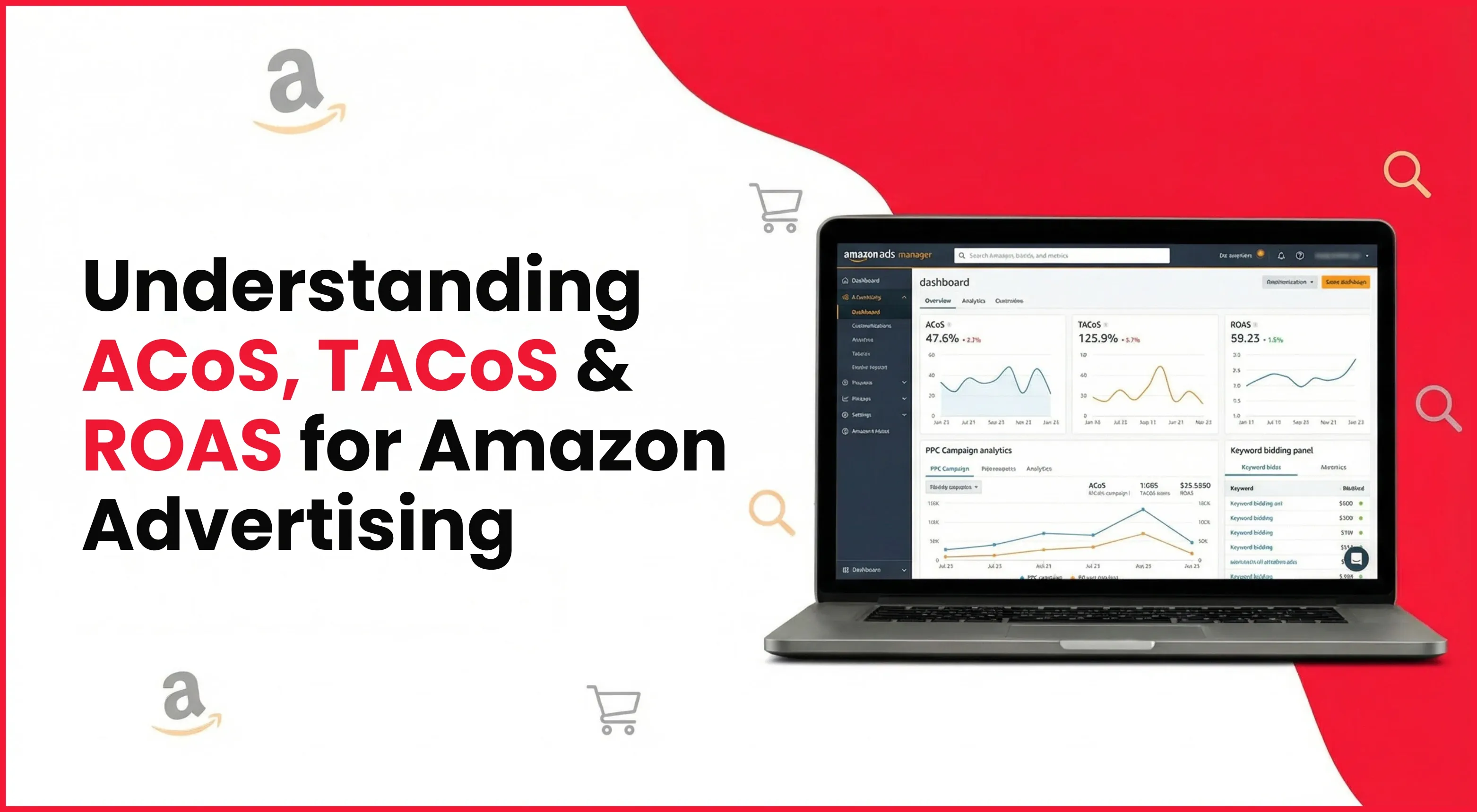
Amazon ads have turned into a powerful tool for sellers to drive traffic, sales, and brand growth. But profitable campaigns require understanding the critical performance metrics that tell you if your ads are effective or just throwing money.
ACoS, TACoS, and ROAS are three of the most important KPIs for Amazon advertising.
If you've never heard these terms before and they are making your head spin, rest easy. This simple guide breaks down ACoS, TACoS, and ROAS, with formulas, examples, and practical advice, great for first-time sellers as well as those with a bit more experience.
Why Metrics Matter in Amazon Advertising
Amazon Ads are based on a pay-per-click (PPC) system. You Pay When Someone Clicks Your Ad. You could waste a bunch of cash on ads and never know if they were making you money if you don't track the right metrics. Learn more about ACoS,
TACoS, and ROAS, so you can:
- Control ad spend
- Increase profit margin
- Scale winning campaigns
- Avoid unnecessary losses
- Make decisions based on Data
What is the difference between ROAS, ACoS, and TACoS?
| Metric | Full Name | What It Measures | How to Read It |
|---|---|---|---|
| ROAS | Return on Ad Spend | How much revenue do you generate for every £1 spent on ads | Higher ROAS = more efficient ads |
| ACoS | Advertising Cost of Sale | The ratio of ad spend to ad-attributed revenue, shown as a percentage | Lower ACoS = better cost control |
| TACoS | Total Advertising Cost of Sale | The ratio of ad spend to total revenue (ad + organic sales) | Lower TACoS = stronger long-term growth |
Simply put:
- ROAS = Return on ad spend, how much you receive for every £ of ad budget you spend
- ACoS = Ratio of ad spend to ad revenue in % terms
- TACoS = total advertising cost of sale, whereby we measure the advertising spend relative to the total revenue generated
Read more: High-Converting Amazon Product Descriptions
What is ACOS in Amazon Advertising?
Amazon ACos stands for ‘Advertising Cost of Sale’, and it represents the amount of money you spend on advertising in relation to the sales you generate for a specific product.
It is vital to your Amazon PPC Advertising, and it plays a major role in determining whether a sponsored product ad campaign is making or losing money.
The relevant metric is always the one that corresponds to the goals you set for your PPC campaigns.
That said, if you want information on your ad campaigns at a more granular level, to find out how much revenue those ad dollars generated, then ACOS can provide you with that particular number.
How to calculate your ACoS
To calculate your ACOS, you need to know both of these:
- Advertising Spend (total cost) is the amount you’ve spent on advertisements during a certain time period.
- Ad revenue, which is the total sales generated from your Amazon ads during the same time period.
You divide these two amounts and then multiply by 100. This is how it would look:
ACOS = (£100/£1000) x 100 = 10%
What is TACoS?
Amazon TACOS is a term that represents the Total Advertising Cost of Sale and takes into account the product of ad spend and cost of goods sold to show a more encompassing overview of Profitability Over TACOS and is therefore preferred in most situations.
It is a valuable metric that encompasses ad revenue and organic revenue, and is a good indicator of how spending on ads is impacting your account health, as well as where you can potentially grow your profit margins. It gives a perception of the forever in your PPC Campaigns.
How to Calculate Your Amazon TACOS
To calculate your Amazon TACOS, you need the following information:
- Ad Spend (Total cost), which is the total amount you’ve spent on Amazon during a specific time period (exactly like the ACOS calculation)
- Total Sales (attribute and non-attributed), which includes all your sales that are directly attributed to your ad campaigns and those that are indirectly influenced by advertising efforts.
You divide these two elements and then x 100! For example,e if you spent £500 on advertising and generated £3000 in total sales during a month, then it would be:
TACOS = (£500 / £3000) x 100 = 16.6%
What is ROAS?
ROAS, which stands for return on advertising spend, is an important online advertising metric to track, whether for Amazon PPC campaigns or other digital advertising. It is a calculation that indicates how much revenue was earned for each dollar spent on advertising.
Knowing the ROAS is critical for both efficient budgeting of advertising spend and for optimal campaigning to achieve the intended goals and profitability.
Understanding ROAS is important to see if your advertising campaigns are profitable and successful. This tells you whether the money that you spent on advertising is truly making enough money. High ROAS means your ads are bringing in more revenue than they cost to run, suggesting a worthwhile investment. On the flip side, if you’re seeing a low ROAS, you may want to look into whether you need to make changes to your marketing strategy to make it more profitable.
How to calculate your Amazon ROAS
To calculate ROAS, you need to know two primary figures:
- Revenue from Ads (Ad Revenue): The total sales generated from your Amazon ads during a specific period.
- Advertising Spend (Total Cost): The amount you’ve spent on advertisements during the same time period.
The formula to calculate ROAS is: ROAS = (Ad Revenue/Advertising Spend)×100
For example, if you generated £1000 in sales from your Amazon ads and spent £100 on advertising during a given period, the ROAS would be calculated as follows:
ROAS=(£1000/£100)×100=1000%
This means for every £1 spent on advertising, you generated £10 in revenue.
Read more: Amazon store management services for every seller
ACoS vs ROAS: Which one is better?
Both metrics are useful, but they serve different purposes.
| Metric | What It Measures | Best Used For |
|---|---|---|
| ACoS | Cost as a % of ad sales | Profit control & campaign decisions |
| ROAS | Revenue per £1 spent | Ad efficiency & channel comparison |
| TACoS | Cost as a % of total sales | Long-term growth & brand health |
Both are useful metrics, but ACoS is more popular for Amazon sellers because:
- The Amazon Ads dashboard displays the ACoS by default.
- Simple to compare with product margins.
- More useful for making decisions at the campaign level.
ROAS is prevalent in Google Ads and Facebook Ads, but it also gives you valuable insights into the efficiency of your ads.
Conclusion
There is no one “best” Amazon ad metric. ACoS is a cost control metric, TACoS is long-term brand growth, and ROAS is ad efficiency overall. The best Amazon sellers combine all three to make smarter decisions.
At Arivan, we enable brands to comprehend and balance ACoS, TACoS & ROAS for crafting profitable and scalable Amazon Advertising strategies. When these metrics are monitored appropriately, sellers have complete control of their ad performance, enabling them to grow sustainably and successfully for the long-term.
Frequently Asked Questions About Amazon Ad Metrics
1. How long will it take for ACoS to converge after launch?
There's no fixed schedule for that. It varies from product to product, competition, and field. A few products can become profitable right away, while others may run at a high ACoS (even up to 100%) for a couple of weeks while they build visibility, collect data, and gain momentum.
2. What if the ad spend and revenue are close (ACoS around 100%)?
This is typical for new or unestablished products, especially in the early days of testing. At this point, “It’s typically not about making profit but to increase traffic and revenue volume.” It’s also normal for daily ACoS to change when sales are low.
3. If ACoS hovers at 100%, is that the same as the brand losing money?
Yes, in the short term, but this is usually planned with product launches. A high ACoS initially is considered a test & learn investment to identify converting keywords and get visibility and reviews. As a product matures, organic sales pick up, TACoS gets better, and hence overall profitability increases.